Robotics · Measurement
What a recorded motion is worth on another arm
We recorded one robot arm doing a task, adapted the recording for two other arms and measured how much it teaches them.
Summary
A robot arm learns a task from recordings of that task, and those recordings usually have to be made on the same arm. In simulation, we recorded an arm picking up and placing a cube, adapted the recordings for two other arms and measured how much each arm learned from them. One adapted recording taught about half as much as a recording made on the arm itself: 0.54 on a similar arm and 0.60 on a different one. Adapting alone, with no change of arm, kept about three quarters (0.74).
The question
A robot arm learns a task from demonstrations: recordings of the task being done. Those recordings normally have to be made on the same arm that will learn from them. A facility with several kinds of arm has to record the same task again for each one.
Earlier work has moved recordings from one robot body to another.2. A study of one learned program across robot bodies: arXiv:2402.192493. A second study across robot bodies: arXiv:2503.00774 We wanted a number for it: if a task is recorded on one arm, how much is that recording worth to a different arm?
Terms we use
- Demonstration: One recording of an arm doing the task from start to finish. An arm learns from many of them.
- Source arm: The arm the task was recorded on.
- Similar arm and different arm: The two arms we taught with the source arm's recordings. The similar arm is built much like the source arm. The different arm is smaller and laid out another way.
- Adapted recording: A source recording worked out again for another arm, so that its gripper follows the same path with its own joints.1. MimicGen, a method that makes new demonstrations from a few recordings: arXiv:2310.17596
- Exchange rate: How many of an arm's own demonstrations one adapted recording replaces.4. A study of human and robot hand demonstrations, which names its own rate an exchange rate: arXiv:2603.222645. Reporting how much data a transfer is worth: arXiv:2102.012936. A second report of that kind: arXiv:2603.06450 At 1, an adapted recording teaches as much as a demonstration made on the arm itself. At 0.5, it takes two to teach as much.
What we did
- In simulation, an arm picks up a cube and places it on a goal.
- We recorded the task on the source arm and adapted those recordings for the similar arm and the different arm.
- We trained the same learning program on each arm twice: once on its own demonstrations and once on adapted recordings.
- We counted how many of each it took to reach the same success. That ratio is the exchange rate.

What we found
- About half. One adapted recording was worth 0.54 of a demonstration on the similar arm and 0.60 on the different arm.
- The kind of arm made little difference. The two rates are too close to tell apart.
- Adapted recordings get nearly as far. With enough of them, each arm came within a tenth of the success it reaches on its own demonstrations.
- Adapting has a cost of its own. We also adapted the source arm's recordings for the source arm itself. With no change of arm the rate was 0.74, so about a quarter is lost in the adapting step alone.
- A demonstration made on the arm itself 1.00
- Adapted, with no change of arm 0.74
- Adapted for the similar arm 0.54
- Adapted for the different arm 0.60
A result we did not expect
We also trained a learning program on the source arm's recordings alone and tried it, with no further training, on the other two arms.
- On the different arm it succeeded about half the time (51%).
- On the similar arm it almost never did (4%).
We had expected the opposite. On the similar arm, most attempts ended with the arm being asked for a position it could not reach. Our reading, which we have not tested yet: what matters is whether the new arm can follow the source arm's paths, more than how alike the two arms look.
Limitations
- Everything here was measured in simulation.
- One task, one gripper and one learning program.
- The demonstrations were made by a program, not recorded from people.
- Two arms were taught. The different arm was picked from those the learning program could learn the task on.
- Our way of adapting recordings loses about a quarter. Another way would give other rates.
- Our reading of the unexpected result is a hypothesis.
Recordings
Each arm trained on its own demonstrations: one success, then one failure of its most common kind.
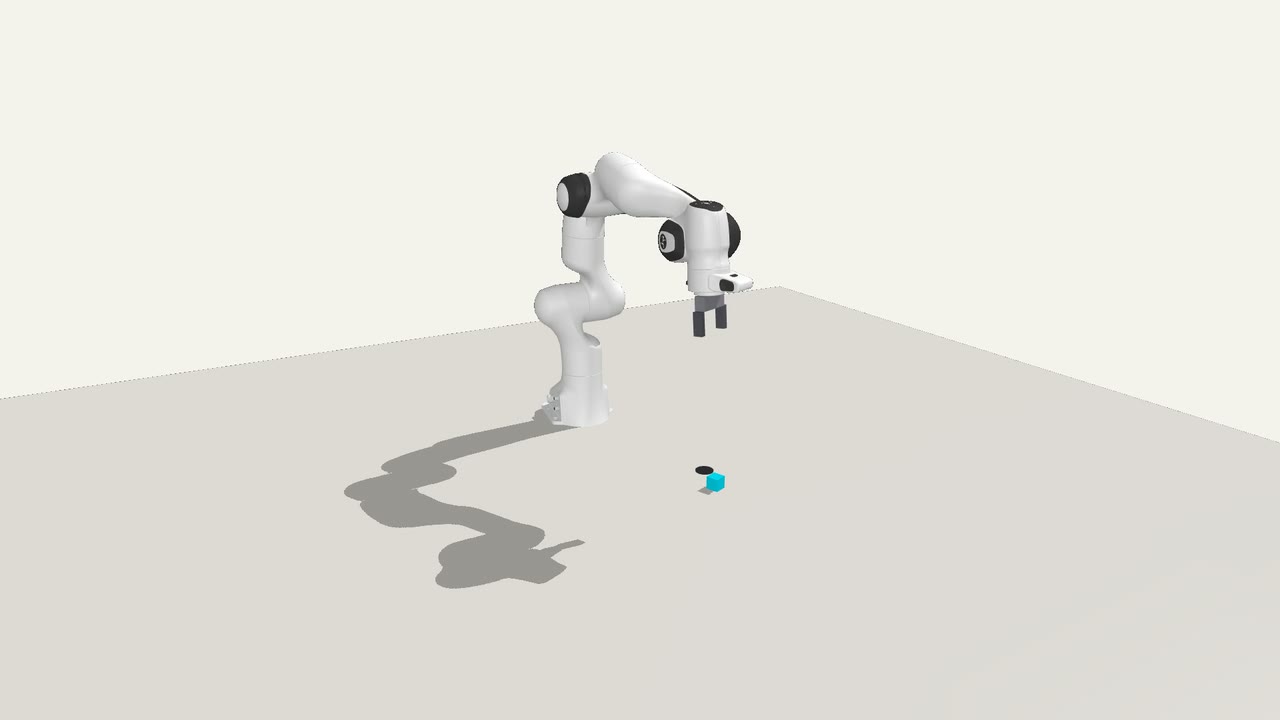
The source arm. 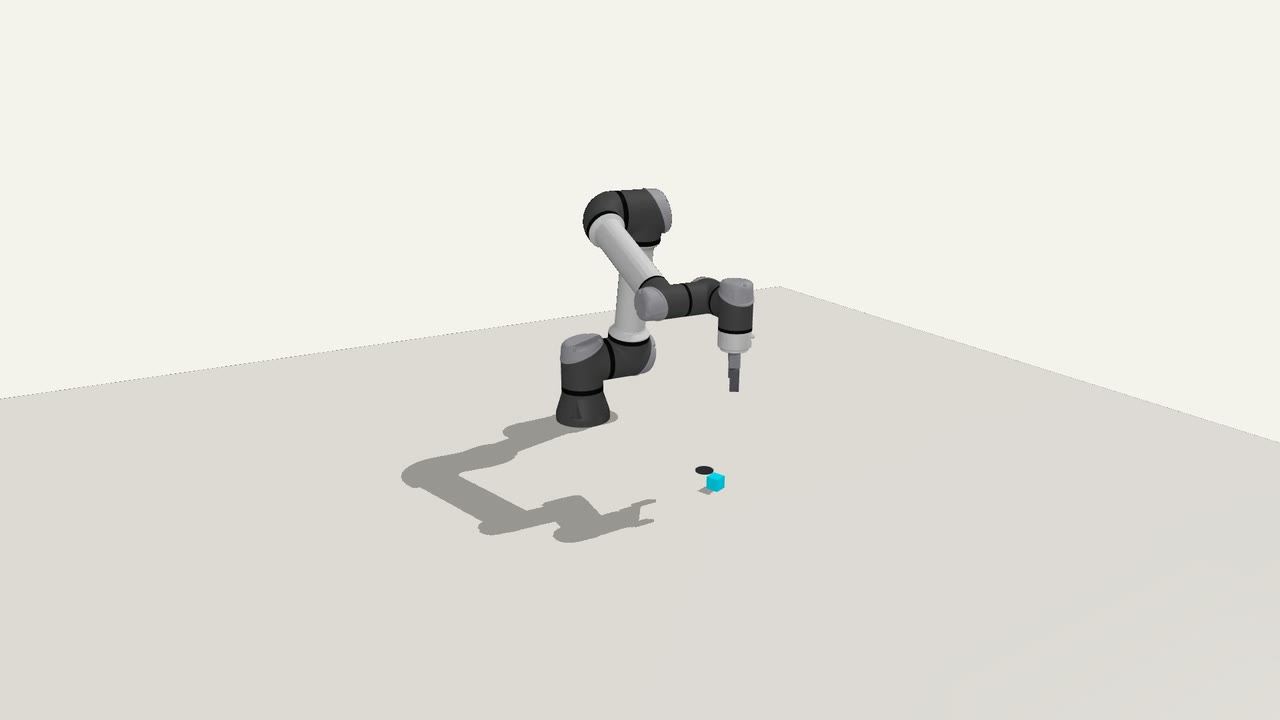
The similar arm. 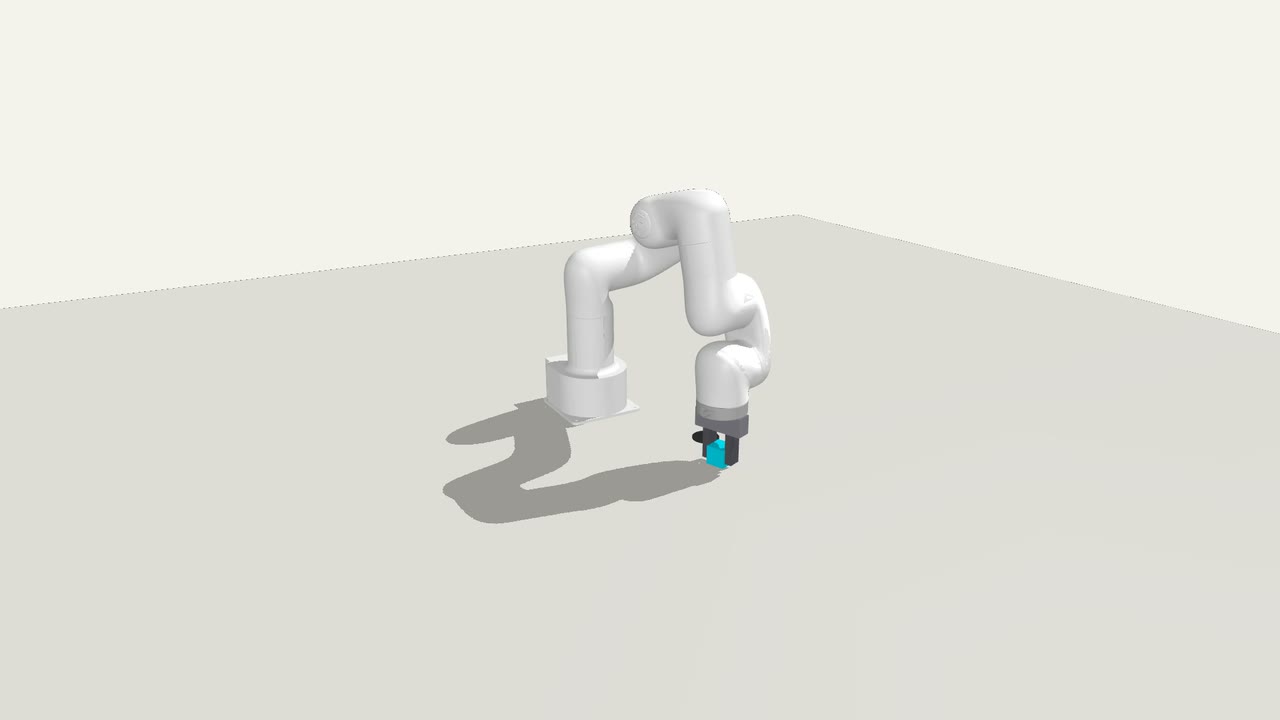
The different arm.


